


Dosing Guide From Call of Beauty
How Many Units of Botox Do You Actually Need?
The real question behind 'is this price fair?' is 'am I getting the right dose?' Our RN injectors break down the typical unit ranges for every treatment area so you can judge quality, not just price.
Forehead
10-20 units for most patients
Frown Lines
20-30 units for the 11s
Masseter
40-100 units total for jaw slimming
Call of Beauty is an Allergan Diamond Provider in Encinitas, which means we inject in the top 1% of practices in the country by volume. After 5,000+ Botox treatments, here's the honest truth about dosing: the right number of units depends on your anatomy, your muscle strength, and your goals, not on a fixed menu.
But there are typical ranges. Knowing them helps you figure out whether a quoted price is reasonable, whether you're being under-dosed (cheap treatments that wear off in 6 weeks), or whether you're being oversold areas you don't need.
This is the guide we wish every new patient had before their first consultation.
Why "Units" Matter More Than Total Price
Botox is priced per unit, not per area. That's the part most patients don't fully understand when they're comparing quotes.
A $10/unit clinic that uses 30 units on your forehead charges $300. A $13/unit clinic that uses 20 units charges $260. Same result, different pricing structures. The per-unit price alone doesn't tell you what you'll actually pay or whether you're getting enough product to see real results.
Three things affect your total dose:
Muscle strength. Someone with a strong frontalis (the muscle that lifts your eyebrows) needs more units than someone with a weaker one. Men typically need more units than women in the same area for the same effect.
Treatment goal. "Soft and natural" uses fewer units than "frozen." Most of our patients want the middle ground: relaxed but still expressive. That usually means starting conservative and adding more at the 2-week follow-up if needed.
Consistency. Patients who've been getting Botox every 3-4 months for years often need fewer units over time because their muscles have become less active. First-timers usually need a higher starting dose.
The Quick Reference: Typical Unit Ranges by Area
Here's the cheat sheet. These are the ranges we see across thousands of treatments at our Encinitas clinic. Your injector will customize within these based on your face.
| Feature | Typical Range per treatment | Cost at Call of Beauty at $13/unit regular price |
|---|---|---|
| Forehead lines (frontalis) | 10-20 units | $130-$260 |
| Frown lines / 11s (glabella) | 20-30 units | $260-$390 |
| Crow's feet (both sides) | 10-24 units | $130-$312 |
| Lip flip | 4-8 units | $52-$104 |
| Masseter / TMJ (both sides) | 40-100 units | $520-$1,300 |
| Brow lift | 4-8 units | $52-$104 |
| Bunny lines (nose) | 4-10 units | $52-$130 |
| Chin dimpling (mentalis) | 4-10 units | $52-$130 |
| Neck bands (platysma) | 25-50 units | $325-$650 |
| Gummy smile | 4-8 units | $52-$104 |
First-Time Patient Pricing
Forehead Lines: 10-20 Units
Horizontal forehead lines come from the frontalis muscle pulling your eyebrows up. Botox for forehead wrinkles relaxes that muscle so the lines smooth out.
Typical dose: 10-20 units. Most women land around 12-16 units. Most men need 16-24.
Why the range is wide: The frontalis varies a lot person to person. Some patients have a short, strong frontalis that needs aggressive dosing. Others have a long, weak one where 10 units is plenty. We can usually tell by looking at how your eyebrows move.
What under-dosing looks like: The lines fade but come back within 6-8 weeks instead of lasting 3-4 months. If your last treatment wore off early, you were probably under-dosed.
What over-dosing looks like: A "heavy" forehead that feels tight or hard to move. You can still see some wrinkles on the sides because the outer fibers weren't reached. Rare when dosed correctly.
One rule we follow at Call of Beauty: we never treat the forehead alone without also treating the glabella. If you relax the forehead but leave the frown muscles active, your brows can drop. Treating both keeps the brow position natural.
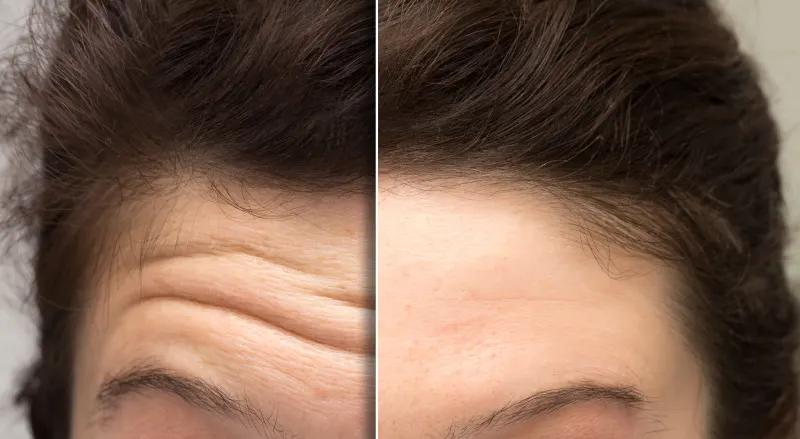
Forehead Before and After: 14 Units
This result came from 14 units of Botox across the frontalis, paired with 22 units in the glabella to keep the brow position lifted. Softer lines, natural movement, no frozen look. That's what proper dosing looks like.
Results peak at 14 days. Touch-ups at the 2-week follow-up are included for first-time patients who need a couple more units.
Frown Lines / The 11s: 20-30 Units
The vertical lines between your eyebrows come from the corrugator and procerus muscles. They fire when you concentrate, squint, or frown. This area (called the glabella) is the single most commonly treated area with Botox, and it's where the FDA originally approved the product back in 2002.
Typical dose: 20-30 units. Most women need 20-25. Most men need 25-35.
Why this area needs more: The corrugator muscles are strong. They're pulling against each other constantly, and they're why people develop deep "11s" between their brows over time. Under-dosing here is the #1 reason patients feel like their Botox "didn't work."
The preventative angle: Patients in their late 20s and early 30s often come in for preventative Botox to soften lines before they become etched in at rest. In those cases, 18-20 units is often enough because the muscles are still relatively untrained.
What 20 vs 30 units looks like: At 20 units, you'll still be able to furrow slightly when you really try. At 30, the area is fully relaxed. Neither is "right" or "wrong." It's a personal preference about how much movement you want to keep.
Crow's Feet: 10-24 Units Total
The fine lines that fan out from the corners of your eyes when you smile are caused by the orbicularis oculi muscle. Treating crow's feet softens the lines without changing the character of your smile.
Typical dose: 10-24 units total, split evenly between both sides. Most patients land at 5-10 units per side.
Why the range feels narrow: The orbicularis oculi is a delicate muscle. Over-treating it can cause the cheek to lift unevenly or the eyelid to feel heavy. We dose conservatively here and add more at the 2-week follow-up if needed.
Smile consideration: Patients with dynamic "apple cheek" smiles sometimes keep the lower crow's feet untreated to preserve that expression. Treating only the upper fibers lifts the wrinkles without flattening your smile.
The eyelid myth: Crow's feet Botox doesn't cause droopy eyelids when it's placed correctly. That complication comes from product migrating to muscles it wasn't intended to hit, usually from inexperienced injection or too aggressive dosing. An Allergan Diamond Provider's technique avoids it.
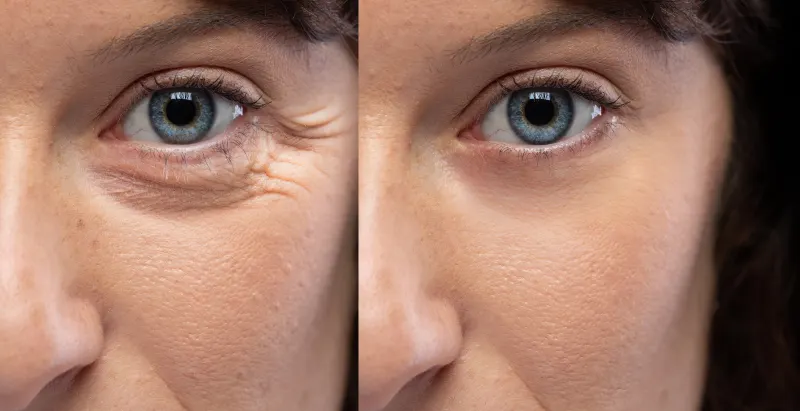
Crow's Feet Before and After: 16 Units Total
8 units per side, placed just at the outer corner of the eye. Lines soften at rest and when smiling. Cheek lift is preserved. This is the result most of our Encinitas patients are after.
Crow's feet typically last a bit longer than forehead Botox, often 4 months. The muscle here is smaller and doesn't have to work against gravity.
Lip Flip: 4-8 Units
A lip flip is one of the smallest Botox doses we do, and one of the most misunderstood. It's not a filler. It doesn't add volume. A few units of Botox placed along the upper lip line relaxes the orbicularis oris so the lip rolls outward slightly when you smile, showing more of the pink.
Typical dose: 4-8 units, placed in 4-6 tiny injection points across the upper lip.
Who it's for: Patients who have a thin upper lip when they smile but don't want filler, or who have a "gummy smile" (more on that below). It's subtle. It lasts 6-10 weeks, shorter than other areas because the lip muscle is active and metabolizes product fast.
Combined with filler: Many of our patients combine a lip flip with a small amount of lip filler to soften the upper lip and add a touch of volume at the same time. The two treatments work well together.
Heads up: Lip flips can make drinking from a straw, whistling, or pronouncing certain letters feel slightly different for the first week. The effect wears off as the product settles.
Masseter / Jawline Slimming: 40-100 Units Total
The masseter is the big chewing muscle on the side of your jaw. When it's overdeveloped (from clenching, grinding, or just genetics), it creates a wider, more square jaw. Botox relaxes the muscle over time, and the jaw slims as the muscle atrophies.
Typical dose: 40-100 units total, split between both sides. Average is around 50-60 units total (25-30 per side) for a first treatment.
Why the range is so wide: Masseters vary enormously in size. A patient with a subtle masseter might need 40 units total. A heavy grinder with a large, dense masseter might need 100 or more to see real jaw slimming.
Why it costs more: This is the most expensive Botox area we treat at Call of Beauty because it requires significantly more product. Patients often ask why masseter quotes range from $500 to $1,300. That's the honest reason: the muscle is huge compared to the forehead.
The timeline is different. Unlike forehead or crow's feet where you see results in 2 weeks, masseter slimming takes 6-12 weeks to appear and keeps improving with repeat treatments. Most patients see peak results after their second or third session.
TMJ and grinding. Masseter Botox also treats TMJ pain and nighttime grinding for many patients. The medical benefit shows up before the aesthetic one, typically within 2-3 weeks of treatment. Some patients come for the jaw pain and stay for the slimming. Others come for the slimming and discover their jaw tension is gone.
Smaller Areas: What They Cost and What They Do
Not every Botox treatment is for a major area. Here are the smaller, targeted uses that add up to $50-$150 each but can make a real difference.
Brow Lift (4-8 units)
Placed just under the tail of the eyebrow to relax the muscle pulling it down. Creates a subtle 1-2mm lift. Opens the eye area without surgery.
Bunny Lines (4-10 units)
The diagonal wrinkles on the sides of the nose when you smile or scrunch. Treated with 2-5 units per side. Often missed by injectors who only treat the big three areas.
Chin Dimpling (4-10 units)
Relaxes the mentalis muscle that creates an orange-peel texture on the chin. Common in patients who've lost collagen in the lower face.
Neck Bands (25-50 units)
Vertical bands on the neck (platysma) from aging or genetics. Softened with small injections along each band. Often combined with filler or Sculptra for a full neck approach.
Gummy Smile (4-8 units)
Small amount placed above the upper lip to relax the muscle that lifts it too high when smiling. Reduces gum show without changing the smile.
Downturned Mouth (4-8 units)
Treats the depressor anguli oris at the corners of the mouth. Softens a resting sad expression. Subtle but meaningful for patients who feel like they look tired.
Do Men Need More Units?
Yes, almost always. The rule of thumb is that men need roughly 30-50% more units per area than women for the same effect. That's because male facial muscles are generally stronger and the muscle mass is larger.
A typical male upper face treatment (forehead + glabella + crow's feet) runs 60-80 units. A typical female upper face treatment runs 40-55 units.
This is covered in more detail in our Brotox guide, including the specific areas men ask about most and how male Botox dosing differs from the assumptions in most online unit calculators.
Preventative Botox: The Younger-Patient Dosing Question
Patients in their mid-20s to early 30s increasingly come in for preventative treatment, meaning they want to soften expression lines before they become etched in at rest.
Typical dose for preventative Botox: 10-15% less than the standard range. A 28-year-old treating her glabella might start at 18 units where a 45-year-old would start at 25. The goal is to calm the muscle, not freeze it.
Treatment frequency: Some younger patients stretch to 4-5 months between treatments once they find their maintenance rhythm. The muscle memory fades with consistent light dosing.
Worth noting: Preventative Botox works best when it's actually preventative, meaning you start before deep lines form. Once wrinkles are etched in at rest, you'll need a combination of Botox plus collagen-stimulating treatments to fully address them. That's where Sylfirm X and biostimulators come in.
How We Dose at Call of Beauty
Every new patient starts with a consultation. No exceptions. We look at your muscle movement at rest, when you animate, and when you're holding expressions like a full smile or a concentrated frown. Then we talk about your goals and whether you want soft, moderate, or full relaxation.
We dose conservatively on the first visit. You can always add more at the 2-week follow-up, but you can't take Botox back. About 25% of our first-time patients come in at 2 weeks for a small touch-up. That's included in your first visit pricing.
We quote in units, not "areas." Some clinics charge by the "area" at a flat rate. That math favors the clinic, not the patient, because you could be paying for 30 units of product and only receiving 18. At Call of Beauty, you're quoted in units and you know exactly what you're getting.
We carry three brands. Botox, Dysport, and Jeuveau are all FDA-approved and equally effective. If you have a preference (or if you've had inconsistent results with one brand), we'll adjust.
We're an Allergan Diamond Provider. That designation means we're in the top 1% of Allergan-partner practices nationally by volume. In practical terms: we inject a lot, we see a lot, and we know what typical unit counts look like for every kind of face.
Our clinic is on N Coast Highway 101 in Encinitas, serving Carlsbad, Del Mar, Solana Beach, Rancho Santa Fe, and Cardiff-by-the-Sea. Same-day appointments are often available.
Call of Beauty Botox at a Glance
What our Encinitas patients can expect
Botox Unit Questions From Our Encinitas Patients
The dosing questions we hear most often in consultations