




Quick Answer
Botox vs Dysport vs Jeuveau: how do they actually differ?
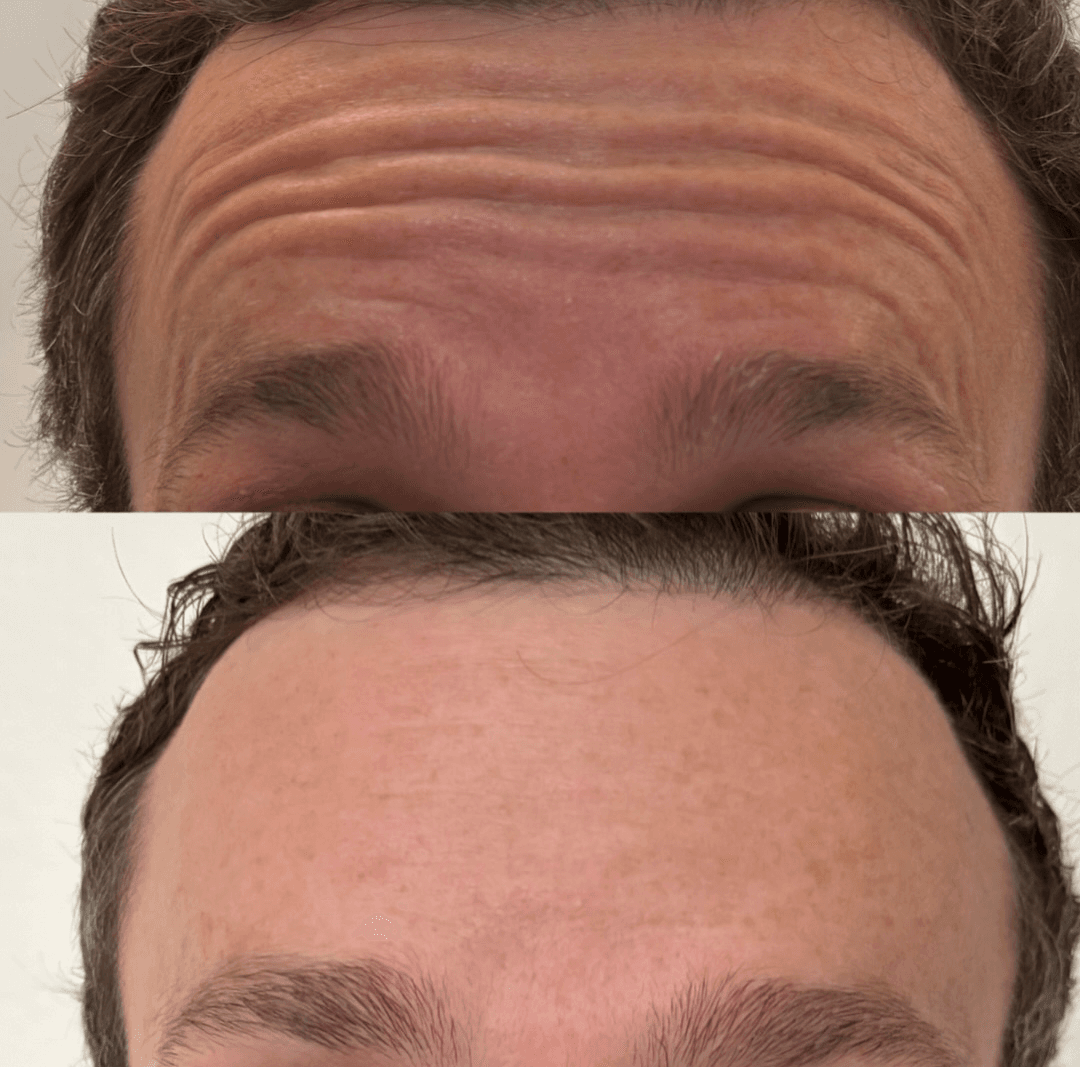
A Dysport unit and a Botox unit are different units of measurement, so unit counts and per-unit prices cannot be compared between the two. Published conversion ratios run about 2.5:1 to 3:1 Dysport to Botox. Across our own visits the median Botox appointment used 36 units and the median Dysport appointment used 120. Dysport tends to show change fastest and spreads a little wider, which suits large flat areas like the forehead. Botox holds placement tightly, which suits precise work near the eyes. Jeuveau performs similarly to Botox and is chosen far less often. All three typically last three to four months.
A Dysport unit and a Botox unit are not the same size. That single fact explains most of the confusion in any Botox vs Dysport vs Jeuveau comparison, and it is why ranking the three on unit count, or on price per unit, tells you almost nothing.
Here is what that looks like in real numbers. Across more than 3,200 neurotoxin visits at our Encinitas studio since February 2024, the median Botox appointment used 36 units. The median Dysport appointment used 120. Same clinic, same injectors, same kinds of faces. Nobody was overdosed and nobody got triple the treatment.
Most Botox vs Dysport vs Jeuveau comparisons end on some version of "they're all great, it depends on your goals." That is true and useless. This one goes through what our own book actually shows.
The Three Products, Briefly
All three are botulinum toxin type A, and all three are FDA-approved for cosmetic use. They work the same way: injected into a specific muscle, they block the nerve signal telling that muscle to contract, and the skin over it stops creasing.
- Botox (onabotulinumtoxinA) has the longest track record and the most published data behind it.
- Dysport (abobotulinumtoxinA) is formulated with smaller protein complexes and is measured on its own unit scale.
- Jeuveau (prabotulinumtoxinA) is the newest of the three and was developed for cosmetic use only.
The differences that matter in practice are narrower than the marketing suggests. They come down to how the product is measured, how fast it shows up, and how far it travels from the injection point.
Why a Dysport Unit Is Not a Botox Unit
This is the part worth reading twice, because it is the source of nearly every "is Dysport cheaper" and "is Botox stronger" question we get.
Units of botulinum toxin are defined by each manufacturer's own assay. They are not an industry-standard measure of quantity like a milligram. A Botox unit and a Dysport unit are measured on different scales, the way a price per ounce and a price per gram are both real prices that cannot be compared side by side.
Published conversion ratios put Dysport to Botox at roughly 2.5:1 to 3:1, with the exact figure varying by treatment area and by study.
Our own median doses land at a ratio a little above that range, around 3.3 units of Dysport per unit of Botox. That is not because we dose Dysport heavily. It reflects which faces get which product: Dysport gets used more often on the forehead and other large flat areas, where more surface is being covered, while Botox is chosen more for tighter work in smaller zones. Treat more area, use more units.
Patients usually arrive at this from the other direction, asking some version of "do I really need double the Dysport to get the same effect?" The answer is yes, roughly triple in our hands, and it is not a sign anything has gone wrong.
Two things follow from this, and both are practical:
- A per-unit price comparison between Botox and Dysport tells you very little on its own, because the two units are not the same quantity. The comparison worth making is the cost of treating the same area to the same result.
- A unit count on its own tells you nothing about how strong your treatment was. If you are comparing notes with a friend, compare areas treated, not numbers.
There is a fair question buried in this, and it deserves a straight answer: if Dysport takes about three times as many units, how can anyone charge the same price per unit for both? They should not. A clinic that prices Botox and Dysport identically per unit is, in practice, charging roughly three times as much to treat the same forehead with Dysport. Our own Dysport unit price is set at close to a third of our Botox unit price for exactly this reason, and you can see both on the Botox and Dysport pages. If a provider quotes you the same per-unit rate for both, ask them to walk you through the total for your treatment before you book.
What Actually Differs in the Chair
Once the unit confusion is out of the way, the real differences are small but not imaginary.
Onset. Dysport tends to show the first change fastest, often in about two to three days. Botox usually takes a few days longer to begin. All three reach their full effect somewhere around the two-week mark, which is when we ask patients to come back if anything needs adjusting.
Spread. Dysport diffuses slightly wider from each injection point. On a broad forehead, that is an advantage, because the result softens more evenly across the area. Near the eyes, where a millimeter of unintended spread matters, tighter control is worth more than even coverage. This is the single most useful difference between the two products, and it is about matching the product to the anatomy rather than one being better.
Everything else. Duration, safety profile, and injection experience are close enough between the three that they rarely decide anything. The needle is the same. The appointment takes about the same time.
How Long Each One Lasts, By Our Numbers
Every brand says three to four months. That range comes from the manufacturers, so it is worth checking against something independent.
Among our patients who came back for a second neurotoxin appointment, the median gap between visits was about 110 days. That is roughly three and a half months, and it sits squarely inside the range the labels claim. About 56% of neurotoxin patients booked a second session with us.
Rebooking intervals are a rough proxy rather than a measurement of how long the product worked. People book around holidays, weddings, and travel. But across nearly 1,800 gaps between appointments, the number is stable enough to say the three-to-four-month claim holds up in ordinary use, and it does not differ meaningfully by brand.
Almost Nobody Switches
Here is the finding that surprised us most, and it runs against most of what gets written about neurotoxins.
Of more than 1,200 patients who have had a neurotoxin treatment with us, only about 10% have ever had more than one brand. The other 90% found something that worked and stayed with it. Among the small group who did try a second product, nearly all of the movement was between Botox and Dysport.
Plenty of articles frame this as a menu you should sample. Our data says patients do not behave that way, and we do not push them to. If your current product gives you a clean result at three months with no drooping and no surprises, there is no clinical reason to change it. Novelty is not a treatment goal.
The honest version of the switching conversation is narrower than the internet's version: there are specific reasons to change product, and "curiosity" is not usually one of them.
Where Jeuveau Fits, and Why We Use It Least
We offer Jeuveau, and it accounts for roughly 2% of the neurotoxin treatments we perform. That share has drifted down each year we have tracked it.
This is not a knock on the product. Jeuveau is FDA-approved, dosed on a scale close to Botox, and performs comparably in the glabellar lines it was studied for. It works.
It stays a small share for ordinary reasons. Most patients arrive already using Botox or Dysport, both of which have longer histories and wider name recognition, and, per the section above, people who are happy do not switch. Jeuveau ends up being chosen mostly by patients starting fresh who specifically want a cosmetic-only product.
We are including this because most comparison articles present all three as equal thirds of a decision, which does not match how the decision actually goes. If you want to try Jeuveau, we will do it. It is simply not what most faces here end up on.
When Switching Is the Wrong Fix
The most common reason patients ask about changing brands is that their treatment "stopped working." Before changing product, it is worth ruling out the more likely explanations, because a brand swap fixes none of them:
- The dose was too low for that muscle. Strong muscles need more product. This is the most frequent cause by a wide margin, and the fix is a dosing adjustment, not a different bottle.
- Placement missed the muscle doing the work. Faces are not diagrams. Movement patterns vary, and a result that fades unevenly often points to mapping rather than product.
- The interval stretched out. Coming in at five or six months instead of three or four means living with several weeks of returned movement, which reads as the product failing early.
- Expectations shifted. Deep static lines etched into the skin at rest do not fully erase with a neurotoxin, whichever brand is used. Those need resurfacing or filler as well.
True resistance to botulinum toxin exists, but it is uncommon, and it is a diagnosis to reach after the above have been ruled out rather than the first assumption.
Neurotoxins are also not for everyone. Anyone who is pregnant or breastfeeding, has a neuromuscular condition such as myasthenia gravis, or has had a reaction to a botulinum product before should discuss it with a physician first. That guidance does not change between brands.
Questions We Get About Picking a Neurotoxin
If you are trying to choose between these products, that decision is easier in person than on a page, because most of it comes down to which muscles are doing the work on your face. We will tell you which product suits the area, what a conservative starting dose looks like, and whether a neurotoxin is even the right tool for the lines that bother you.
This article is for educational purposes and reflects our clinical experience at Call of Beauty Med Spa in Encinitas, CA. It is not individual medical advice, individual results vary, and you should consult a licensed provider about your own health history before treatment.

Not sure which neurotoxin fits your face?
Book a consultation and our RN team will match the product to the areas you want treated, starting conservatively and adjusting at two weeks.
Keep reading
More RN-written guides on neurotoxins and what to expect from treatment.
Sources
- U.S. Food & Drug Administration. BOTOX and BOTOX Cosmetic (onabotulinumtoxinA) Information.
- American Academy of Dermatology. Botulinum Toxin Therapy.
- Scaglione F. Conversion Ratio between Botox, Dysport, and Xeomin in Clinical Practice. Toxins (Basel).
- Galderma. Dysport Product Information.
- Evolus. Jeuveau (prabotulinumtoxinA-xvfs).
Treatment volume figures reflect aggregate, anonymized appointment records from Call of Beauty Med Spa, Encinitas, February 2024 through July 2026. Individual dosing varies.